



خبير في آلات التعبئة والتغليف. يتمتع بخبرة في تصميم أنظمة وضع الملصقات الآلية بالكامل ودمج خطوط الإنتاج المخصصة، وقد ساعد المصنعين في أكثر من 30 دولة حول العالم في ترقية قدراتهم في مجال أتمتة التعبئة والتغليف.


خبير في آلات التعبئة والتغليف. يتمتع بخبرة في تصميم أنظمة وضع الملصقات الآلية بالكامل ودمج خطوط الإنتاج المخصصة، وقد ساعد المصنعين في أكثر من 30 دولة حول العالم في ترقية قدراتهم في مجال أتمتة التعبئة والتغليف.
Automatic Filling, Capping & Labeling Line for Liquids
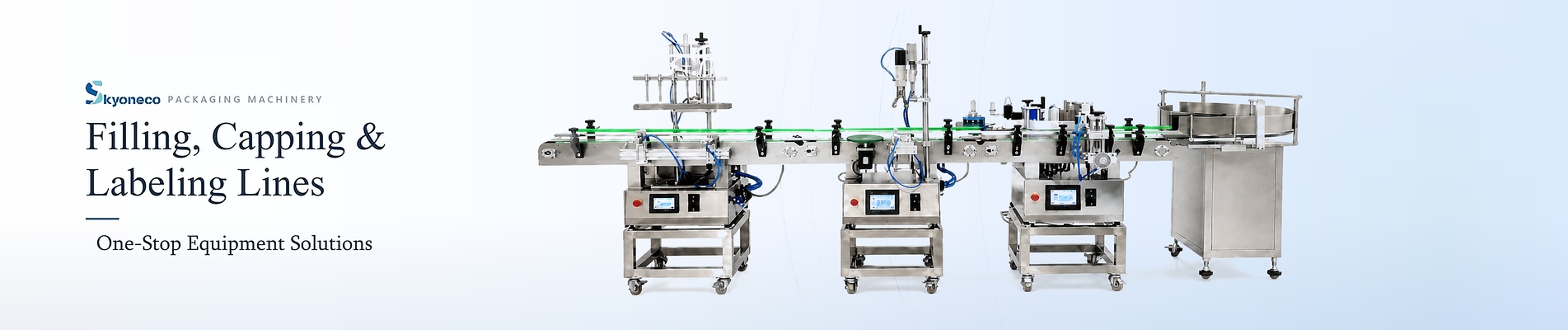
One automatic line for filling, capping and labeling edible oil, sauces and honey — stainless steel construction, PLC control, 12-month warranty and lifetime online support.
Packaging is usually where margin quietly disappears. A producer can negotiate raw materials down to the last cent and still lose money at the filler — through overfilled bottles, rejected labels, leaking caps, and the labour it takes to keep three disconnected machines talking to each other.
For small and mid-sized manufacturers of edible oil, sauces, pastes, honey and syrups, moving from semi-manual filling to a synchronized automatic line is typically one of the biggest operational upgrades available. An integrated liquid filling production line combines multiple packaging processes into one coordinated workflow. This guide explains how an automatic filling, capping and labeling line works, where it delivers the most value, and what to check before specifying equipment.
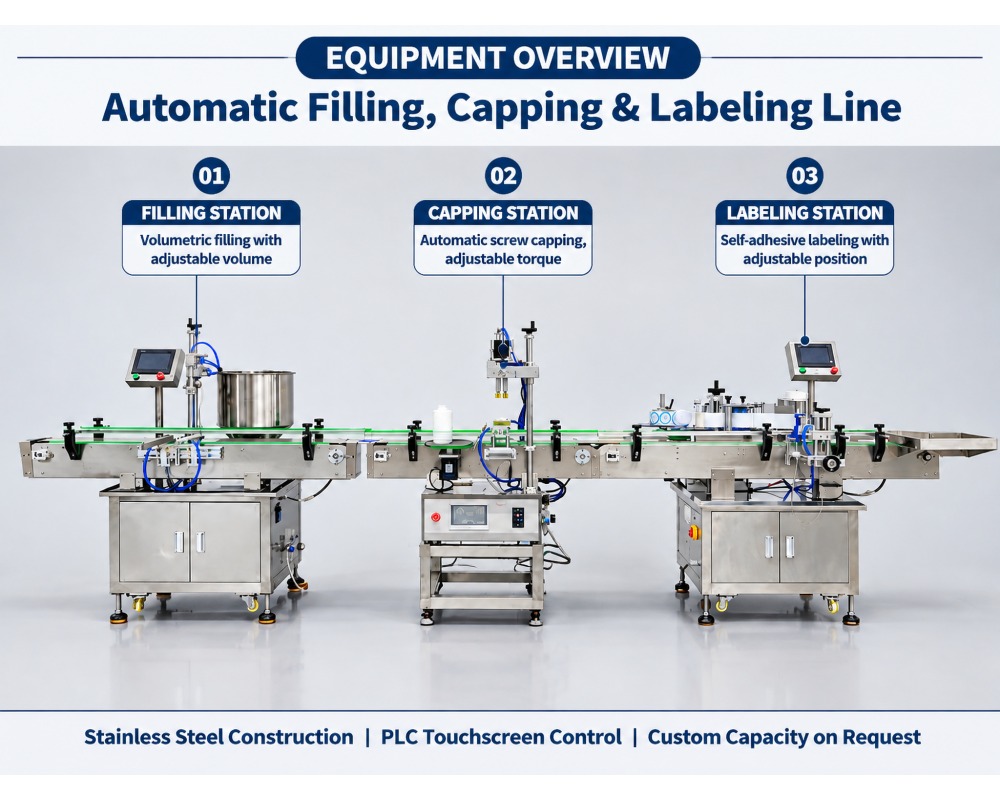
Volumetric filling with adjustable volume, driven from the PLC touchscreen. Volume is set as a recipe rather than by mechanical adjustment, so switching from a 500 ml bottle to a 5 L jerry can is a parameter change, not a rebuild. Nozzle configuration and fill profile are matched to product viscosity, which matters most for foaming oils and thick, chunky sauces where a fast fill can cause bridging and splashing. Choosing the right automatic liquid filling machine helps manufacturers maintain consistent filling accuracy across different product types and container sizes.
Automatic screw capping with adjustable torque. Torque is set to the cap and container combination and held consistently across the run, which helps prevent leakage claims and protects your brand at the point of sale. Change parts accommodate different cap diameters and heights within the line's operating range. For manufacturers handling different bottle and closure specifications, an appropriate automatic bottle capping machine is essential for achieving reliable and consistent sealing performance.
Self-adhesive labeling with adjustable positioning. Sensor-triggered application keeps the label square to the container and at a repeatable height, whether you run a single wrap label or front-and-back labels. Position adjustment is mechanical and requires minimal tools, so a product changeover does not turn into a lengthy maintenance session. Integrating an automatic labeling machine into the production workflow helps improve label consistency and the overall appearance of finished products.
The line is built on a stainless steel frame with washdown-friendly surfaces, mounted on casters with leveling feet so it can be positioned and then locked down. A single PLC and touchscreen control the whole line, with recipe memory for repeated products and alarms that tell an operator which station needs attention instead of stopping the line silently.
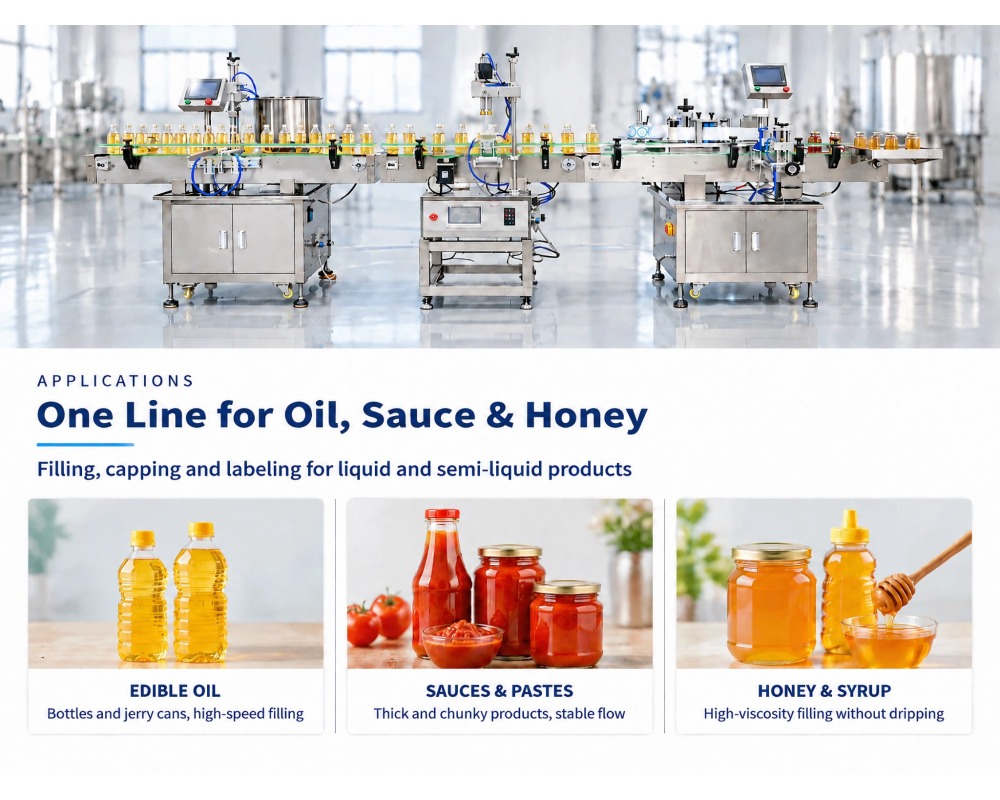
The same platform covers a wide range of liquid and semi-liquid products, which is why one integrated system can often replace several disconnected manual processes. Selecting the right automatic filling, capping and labeling production line depends on product characteristics, bottle specifications and the required production capacity.
Edible oil. Bottles and jerry cans at production speed. Low-viscosity oils are easy to overfill and splash, so fill profile control and drip-free nozzle shutoff play an important role in reducing product waste.
Sauces and pastes. Ketchup, chili sauce, tomato paste, jams and fruit fillings. These products are thick and often contain particles, making stable and repeatable flow more important than raw speed. For these applications, a suitable sauce filling machine with a rotor pump and stirring function can help maintain material consistency during filling and reduce separation or sedimentation.
Honey and syrup. High-viscosity filling requires careful control to minimize dripping and filling inconsistencies. Honey is a high-value product sold by net weight, so filling accuracy directly affects production costs. A suitable filling system should match the product's viscosity and container requirements while maintaining a clean bottle neck for subsequent capping and labeling.
Adjacent products. Dressings, vinegars, liquid condiments and similar flowable products can also run on the same platform, provided they fall within the machine's viscosity and container range. This is an important compatibility question to confirm with the manufacturer before ordering.
Machinery is a long-term investment, so the support model matters as much as the technical specification. Beyond equipment performance, manufacturers should consider installation guidance, maintenance availability and spare parts support.
12-month warranty. Full coverage on the line for the first year, covering manufacturing defects and component failure under normal operating conditions.
Lifetime online after-sales service. Support does not stop when the warranty does. Remote diagnostics, video-guided troubleshooting and commissioning assistance are available throughout the machine's service life, helping reduce unnecessary downtime and maintenance delays.
Complete export documentation. Every shipment is prepared with the documentation package required for customs clearance and destination-market entry, helping simplify the import process.
Installation, training and spares. Guidance through installation and operator training, plus a recommended spare-parts list so consumables and wear items can be stocked before they are needed.
The mechanisms inside a filling line look simple until something drifts. More than 50 R&D technology patents across the filling, capping and labeling mechanisms underpin the design — including nozzle and valve behaviour, torque control, and label application geometry. For a buyer, the practical value is not the patent count itself but what it implies: the design has been developed with real production challenges in mind, and the manufacturer has an engineering team that can respond when your product does not behave like the standard case.
Before purchasing an automatic liquid packaging system, manufacturers should prepare detailed production information. This helps the equipment supplier evaluate the appropriate filling method, machine configuration and production line layout.
| Item | Why It Matters |
| Container range (diameter, height, volume) | Determines change parts and conveyor width. |
| Product viscosity and behaviour | Sets nozzle type, filling profile and tubing. |
| Target output (bottles/hour or per shift) | Defines station count and line speed. |
| Cap type and diameter | Determines capping head and torque range. |
| Label size and format | Determines labeling station configuration. |
| Floor space and layout | Determines line length and orientation. |
| Available power and air supply | Determines utility requirements. |
| Destination market and certifications | Determines the required documentation package. |
Choosing the right automatic filling and packaging equipment is not simply about machine speed. Product viscosity, filling accuracy, container compatibility, capping stability and labeling precision all influence the long-term performance of a production line. A properly configured system should meet current production requirements while allowing room for future product variations and capacity upgrades.
Send your container specifications, product samples and target output to the equipment supplier. This allows the manufacturer to recommend a suitable configuration based on your actual production requirements rather than a generic machine setup. Warranty terms, after-sales service and export documentation should also be clearly confirmed before placing an order.

مزود حلول متكاملة لآلات وضع الملصقات.

دعم فني متخصص على مدار الساعة طوال أيام الأسبوع

إرشادات فنية احترافية.

للتواصل مع الدعم عبر البريد الإلكتروني.
ترك رسالة
امسح ضوئيًا إلى WeChat/WhatsApp :
